BREAKING: Judge Denies MTA's Plans at Dorsey & Foshay!


As covered in:
EVERY ONCE IN A WHILE DAVID LANDS A GOOD ONE ON GOLIATH

In a landmark decision regarding the MTA/Expo Line Construction Authority's two proposed Expo Light Rail Line crossings next to 2,100-student Dorsey HS and 3,400-student Foshay Learning Center, California Public Utilities Commission (CPUC) Judge Kenneth Koss ruled MTA's plans unsafe, and the community and LAUSD's safety concerns valid. The ruling is a tentative decision that will either be adopted or amended by the full CPUC commission on November 21, and it is a major milestone in a heated struggle pitting a scrappy South LA community coalition with the support of LAUSD, against the MTA and their local elected leaders building the project.

Judge Koss’ influential decision recommends the CPUC deny both proposed crossings and MTA submit the appropriate environmental review documents regarding the alternative options.

This is a major battle victory in a long and unfortunate war.

We are relieved that the Judge heard the concerns of the rail safety experts, traffic experts, LAUSD and the community. And we are regretful that the Commission didn't allow hearings on any of the other crossings, and basically rubber-stamped them believing what MTA said.

Two crossings went to hearing and two crossings were found to be unsafe by the judge. We believe that as the evidentiary hearings on Farmdale and Harvard Avenues revealed, the 'evidence' used by the MTA and Expo Authority to support their assertions that they are building a safe project is both unfounded and has been manipulated. (More on that this weekend)

The manipulation of data, unfounded assertions, and dismissal of valid safety concerns for decades, speaks volumes to the deficient rail safety cost-benefit analysis that our region's transportation agencies and politicians have been implementing with impunity. Our transportation agencies’ Ford Pinto cost-benefit analysis is why the MTA's Blue Line at 90 deaths and over 821 accidents, is by far the deadliest light rail line in the country, and Metrolink is one of the deadliest commuter rail systems in the country.

MTA simply doesn't value life.

For more about our response to possible project delay, the cost of redesigning the crossings, the project's financial background, excerpts from the evidentiary hearing, and excerpts from the Judge's proposed decision, and our requests of our elected representives click here to continue reading...

RE: POSSIBLE PROJECT DELAY

If the Judge's proposed decision is adopted by full CPUC, it may delay the full opening of Phase 1 of the line to Culver City, currently scheduled to begin service in 2010.

And true to form MTA's inflated estimates of delay and cost, exaggeration of impacts of the more expensive elevated and trench options, and undervaluing of the impacts of the cheaper options is a textbook example of a public agency cooking the books. This is their attempt to blackmail the Commission into approving unsafe crossings next to our schools of all places.

First off, since when is building something more quickly more important than building it safely?

Second, let’s look at the facts: On the stand MTA's executive admitted they could build up to the previous station and begin service.

UCA/Fix Expo Question: Assuming the regulatory approvals were granted to operate the line in the segmented way that's described in Exhibit 21, wouldn't Metro then be able to operate the line in that fashion?

Expo Authority Executive Eric Olson's Answer: That would be a decision of the Metro Board to make.

UCA/Fix Expo Question: But again, physically possible; right?

Olson's Answer: I mean, as far as the construction goes, yes.

Exhibit 21 is Pg. 2.4-72 of the Expo Line EIR (large pdf) which reads:
Partial Operation Construction Option

The Partial Operation Construction Option would phase-in LRT operations in three segments as construction milestones are met. LRT operations from 7th Street/Metro Center to the Vermont Station would begin upon completion of this portion of the Project's route in approximately 2008; while LRT operations to the Crenshaw Station would begin upon completion of this segment in approximately 2010. The final segment, from Crenshaw Boulevard to the Venice/Robertson Station, would be scheduled for completion in 2012.

And more importantly, the full line to Santa Monica isn't even scheduled to open until 2014-2015 - at the earliest!

There is no need to rush to compromise safety.

It is more important that we get this right, make the appropriate investments on the front end to save lives - particularly the lives of children, so the public isn't paying on the back-end with accident lawsuits and inexplicable pain from deaths and injury. This is a 100 year project - build it right.

Furthermore, if there is a delay to the project, the delay is of MTA's own making and due to the failure of political leadership to address legitimate community concerns.

As we showed in a post earlier this week, MTA's own documents on this project prove that from its inception, the community has repeatedly and loudly said that the street-level crossings, in particularly near our schools, are not safe and were unacceptable. But out of bureaucratic arrogance and political indifference, MTA and our political leaders have fought the community at every turn.

RE: THE COST OF REDESIGNING THE CROSSINGS

In the backdrop of one of the most horrific train accidents in this country's history that cost us 26 innocent lives, seriously injured and maimed 135 people, and has made our region's public transportation agencies an embarrassment to the world, please tell us that our elected officials and transportation agency bureaucrats aren't claiming that they don't have the money to make the Expo Line safe.

Tell us that they've learned their lesson - unfortunately the hard way.

Tell us that they're not still of the mindset that has led to hundreds of preventable deaths on our tracks like last month’s Chatsworth accident. Tell us they don’t still believe that time and money is more important than saving peoples lives and limbs.

This is the problem with the term "safe." It is by definition a relative term subject to misinterpretation by elected officials.

For example, before the Chatsworth accident it was too expensive to implement positive train control and that segment of track was 'safe.' After the tragedy it is clearly unsafe and the cost of the technology is a drop in the bucket. It shouldn't take multiple deaths and worldwide embarrassment to make our elected officials realize that.

RE: BACKGROUND REGARDING THE FINANCIAL HISTORY OF THE PROJECT

In 2004, MTA pulled this project out of the federal New Starts program, in the process walking away from $320 million federal dollars, saying they'd build the project primarily with state and local money instead, because they wanted to speed up construction. That doesn't sound like an agency that can't afford to build grade separation to me. That sounds like an agency with plenty of financial options.

In the past year alone, MTA has appropriated $222 million extra dollars to the now $862 million project, including $54 million to add an overpass in Culver City to Phase 1 of Expo. And they appropriated these funds while telling us with a straight face that there's no money for additional grade separation in South LA.

It is insulting to the intelligence of the people that have followed this issue to suggest this multi-billion dollar agency led by the most powerful politicians in the county, can't find a way to make the Expo Line safe in our community - particularly right next to our schools.

MTA has the resources. MTA has many options - they can scale the project back for one. The fundamental problem is MTA has and unfortunately continues to lack a concern for safety in South LA.

RE: EXPERT EXCERPTS FROM THE EVIDENTIARY HEARING

At the evidentiary hearing three expert witnesses testified on behalf of the community group including Professor Najmedin Meshkati, an internationally renowned expert in human risk analysis and creator of USC’s Transportation System safety program, Ed Ruszak an nationally-renowned expert in traffic impacts and vehicular accident causation, and West Point graduate and retired Major Russ Quimby, who for 22 years led the rail and rail-transit accident investigation group at the National Transportation Safety Board before he retired in 2007.

Quimby testified that there was a high risk of catastrophic accident from MTA’s street-level crossing plan at Farmdale Ave, which abuts the school's property line, and where after-school every day 700 hundreds of students flood the narrow sidewalks in 15 minutes at rates as high as 108 per minute:

As proposed, the Farmdale Avenue crossing creates a high risk that students will be injured and killed because the proposed safety mitigation measures essentially put the burden on students to maintain their own safety. The proposed crossing also creates a higher risk of a catastrophic accident. [....]

By 'catastrophic accident,' I mean an accident involving fatalities and/or injuries to a large number of people. As proposed, the at-grade Farmdale Avenue crossing creates the notable risk that a catastrophic accident may well occur under one of several different scenarios."
(More excerpts from Quimby's testimony.)

EXCERPTS FROM THE JUDGE'S DRAFT DECISION (link to the full draft decision)

"Expo Authority proposed a state-of-the-art system of gates and other warning devices at the Farmdale crossing, including swing gates to allow pedestrians to exit the rail right-of-way when all other gates are down. All of these gates, however, can be avoided easily by pedestrians. Considering the large number of crossings during peak periods, and the student populations using the crossing, we find that any system of gates or other warning devices at-grade would not eliminate all potential safety hazards."

"The parties discussed several other crossings at or near school sites along other light-rail lines. However, none of these cases presented the unique characteristics of the proposed Farmdale crossing at Dorsey. This issue, therefore, provided little or no weight in our determination of practicability."
[....]
"A.07-05-013, for authority to construct an at-grade crossing at Farmdale Ave. in the City of Los Angeles, should be denied.

"Authorization to construct a light rail line over an existing pedestrian tunnel crossing at Harvard Blvd., in the City of Los Angeles, requested in A.06-12-020, should be denied."

OUR FINAL PLEA TO THE CITY COUNCIL

Prior to the issuance of the decision, we delivered a statement on Wednesday before the LA City Council challenging the other members of the chamber to intervene and persuade our local black council members and MTA who have ignored legitimate concerns and data and instead, "declared war on the very community they were elected to serve and the neighborhood council system in general."

We believe it is now incumbent upon our elected officials from the council members to the congressional leaders, to do the responsible thing and listen to the safety concerns expressed by the experts and Judge, and take into account the impacts to the community and schools of the grade separated options. This is a transportation project that will impact this community and serve this region for 100 years. It is important we have a safe light rail line that is a compliment and a good neighbor to the South LA communities that it passes through.

Our intent is to now go back to the community and discuss this draft decision further, but for now we are relieved that MTA’s unsafe street-level crossing was denied – it is a cause for celebration. Today the judge choose life over the risk of death next to our schools.

Stay tuned for the next community meeting, likely the week after the election.

MTA Pleads the 5th on Expo = Blue Line Questions

On July 5, 2007, Save Leimert, a lead member of the Fix Expo Campaign, sent a letter to the MTA and Expo Authority Chairs requesting that they essentially admit that they're building another Blue Line with the Expo Line design, and put to paper the design differences between the environment, track alignments, and traffic conditions, between the Expo Line and Pasadena Gold Line. (View the letter)

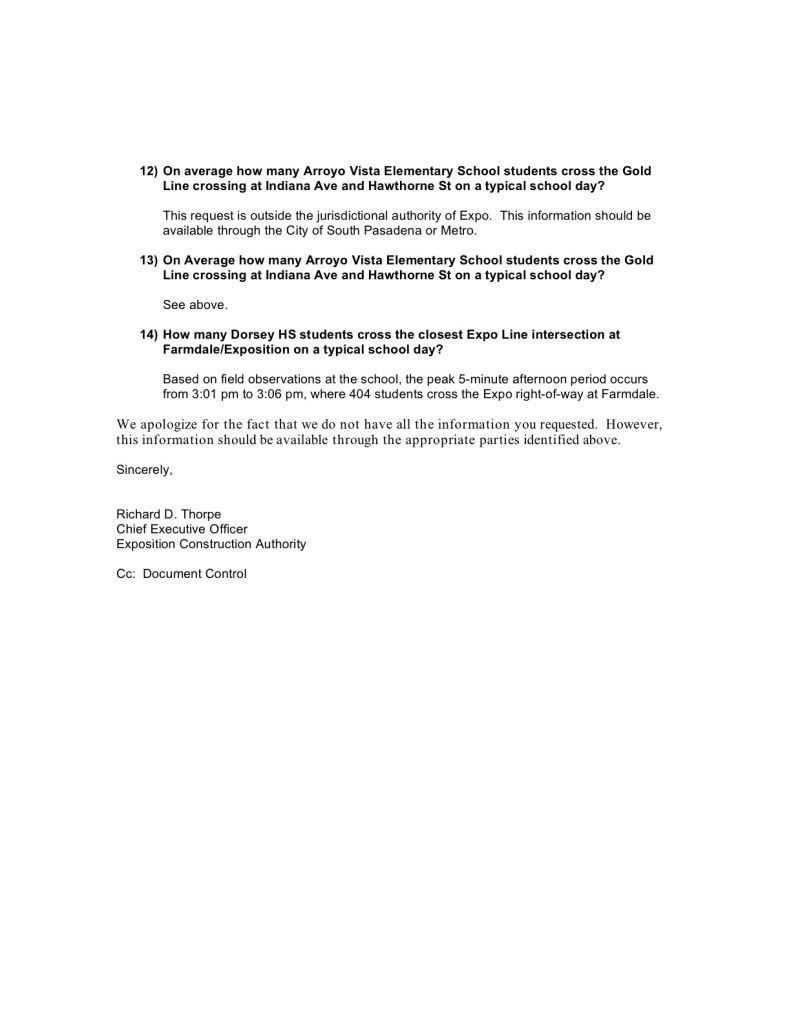
Expo CEO/MTA executive Rick Thorpe pleaded the Fifth to almost all of the questions asked (see below). "This request is outside the jurisdiction of Expo" was Thorpe's response to 12 of the 14 questions in one form or another.

The fact that MTA/Expo believes they can sell the project as one thing, and then when confronted with facts showing it's another, refuse to answer stakeholders questions, exposes their willful deception and disrespect of the community, which Expo Authority is supposed to serve.

To see Expo/MTA pleading the Fifth, continue reading...

True Rail Problem: At-Grade Deaths - Meshkati

Professor Najmedin Meshkati's op-ed on grade-crossing deaths, titled "Grade-crossing Deaths Are True Rail Problem" ran in the Daily News:

According to the Federal Railroad Administration, 74 people have died in Metrolink crashes since 1999 in California, out of which 20 have been killed in grade-crossing accidents. Ninety people have died on the MTA's 22-mile L.A.-to-Long Beach Blue Line, which has had more than 821 recorded incidents between its inception in July 1990 and last July.

The above-mentioned, significantly higher-than-national average rates of accidents and fatalities along the Metrolink and MTA rail network attest to the dire state of rail safety, which is primarily caused by outdated and messy safety-related policies, procedures and practices.

One of the requisite pillars for the safety of any modern technological system's safety today is transparent, total-system-oriented accident and incident investigations, including the reporting of them and unfettered access to them by analysts or any interested party. This pillar is either broken or missing at both Metrolink and MTA.

Other serious system-related problems that have plagued our rail safety include the tragically narrow MTA Grade Crossing Policy for Light Rail Transit and the woefully incomplete MTA Grade Crossing Preliminary Hazard Analysis, which has been used in the now-under-construction Exposition light-rail project.

If the link breaks, here is the full text of the op-ed:

Grade-crossing Deaths Are True Rail Problem
By Najmedin Meshkati

If there is a silver lining to the deadly Metrolink crash in Chatsworth last month, it is the heightened attention to rail safety in the country, and especially in Southern California.

At the federal level, the House of Representatives passed sweeping rail-safety legislation last week that requires more rest for workers and technology that can stop a train in its tracks if it's headed for a collision. This rail-safety bill was passed by the Senate this week, and it is expected that President Bush will sign it into law soon.

At the state level, last week the Metropolitan Transportation Authority and its board, chaired by Los Angeles Mayor Antonio Villaraigosa, voted unanimously to approve a series of safety directives for Metrolink. And last Friday, the Metrolink board of directors unanimously passed a wide-ranging measure to improve safety that included adding a second engineer to some of its trains, using technologies to slow or stop trains when a warning signal is not heeded, and appointing a panel of experts to recommend safety improvements.

These are all good steps. However, it's unrealistic to hope that by showering our transit-rail-system operators with more cash and throwing high technology at their safety problems, we will be much safer.

The lion's share of the earmarked funds are for new devices that could only slow down or stop a train locally or remotely, as in the case of positive train controls. They would not have any impact whatsoever on the other major causes of deaths on the tracks on our light-rail and high-speed commuter rail systems, which are grade-crossing accidents.

According to the Federal Railroad Administration, 74 people have died in Metrolink crashes since 1999 in California, out of which 20 have been killed in grade-crossing accidents. Ninety people have died on the MTA's 22-mile L.A.-to-Long Beach Blue Line, which has had more than 821 recorded incidents between its inception in July 1990 and last July.

The above-mentioned, significantly higher-than-national average rates of accidents and fatalities along the Metrolink and MTA rail network attest to the dire state of rail safety, which is primarily caused by outdated and messy safety-related policies, procedures and practices.

One of the requisite pillars for the safety of any modern technological system's safety today is transparent, total-system-oriented accident and incident investigations, including the reporting of them and unfettered access to them by analysts or any interested party. This pillar is either broken or missing at both Metrolink and MTA.

Other serious system-related problems that have plagued our rail safety include the tragically narrow MTA Grade Crossing Policy for Light Rail Transit and the woefully incomplete MTA Grade Crossing Preliminary Hazard Analysis, which has been used in the now-under-construction Exposition light-rail project.

Villaraigosa has already offered good and specific policy recommendations for transportation safety in a report titled "After Sprawl: Action Plans for Metropolitan Los Angeles (2003)." This report, which I had the privilege of contributing to in 2002 is, according to his official mayoral biography, "a policy blueprint for addressing the issues facing many urban centers."

What he now recommends concerning the major safety improvements of the MTA and Metrolink rail network in the Southland is precisely what he suggested previously in his report. We are simply asking him to put the money where his mouth is by helping implement his vision.

Najmedin Meshkati is a professor at the University of Southern California. He teaches and conducts research on the safety of technological systems and created USC's Transportation Safety Program in 1992.

Accident Rates: Freeways vs. Light Rail


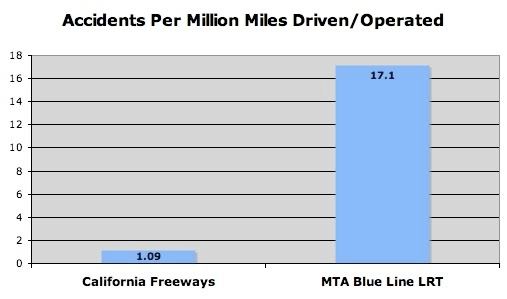
As the stats show, trains pose a significantly greater safety hazard than any other vehicle on the road.

The reasons why are not difficult to understand:
  • MTA's light rail trains are much heavier than anything else on the road (no 225-ton motor vehicle would be allowed on the streets.  The Army's Abrams Tank is comparatively 70 tons)
  • MTA's light rail trains can't stop on a dime
  • MTA's light rail trains don't have steering wheels, so they can't turn to avert or lessen impacts
  • MTA's light rail trains have couplings at the front of the train (see below)

MTA tries to spin this fact primarily one of two ways: deceptively comparing raw data between cars and trains, and by using stats that tell nothing about the hazards street-level light rail vehicles pose to fellow motorists, pedestrians and cyclists.

1) MTA compares raw data between cars and trains.

MTA claims that significantly more people die from car accidents every day than light rail, thus "light rail is safer." But there are millions of vehicles on the road every day, while there are only 250 Blue Line trains during a week day, and only 185 during the weekend. The amount of Blue Line trains that travel across a busy intersection in Downtown LA in an entire day (250) is equal to the number of cars in just one lane of traffic, going in just one direction, across just one intersection in just 30 mins during rush hour. Simply, there are exponentially more cars on the road, so of course there are going to be more accidents and deaths with cars, just as there is sure to be more violent deaths in the Canada (population 33,000,000) than there are in Compton (population 95,000).

How hard would you laugh at the suggestion that Compton is safer than Canada?

2) MTA uses passenger mile accident/fatality rate statistics instead of train mile accident/fatality rate statistics.

Train miles is the distance a train travels, while passenger miles is the combined distance passengers on the train have traveled.

For example, if one Blue Line carrying 50 passengers travels 10 miles it will have traveled:
10 train miles, and
500 passenger miles (50 passengers X 10 miles = 500 passenger miles)

If the train has one accident, the accident rate is 1 accident per 500 passenger miles, which looks a lot safer than 1 accident per 10 train miles.

But a 3-car train carrying 10 people will kill a pedestrian, motorist or cyclist just as dead as a train carrying 100 people.

MTA's spin tactics regarding the hazards of at-grade rail are a statement to their desperation and deception in selling these street-level projects. At Fix Expo, we believe in dealing with reality. We believe the increased hazard of light rail trains requires increased safety mitigation measures, especially grade separation in dense urban areas, which requires a capital investment that our politicians are not currently willing to make (unless you're a city like Culver City that will threaten to oppose the project legally or politically).

Instead, MTA pushes at-grade rail and forces local cities and communities to fight for upgrades, all so they can give the appearance of doing something about traffic. (In reality they're making it worse!). Simply, our politicians have falsely translated our region's desires for traffic relief into a light rail system built on the cheap and unsafely. It is a culture that does not value lives.
  • Blue Line accident rate from the June 2008 MTA Summary of Metro Blue Line Train/Vehicle and Train/Pedestrian Accidents (July 1990 - June 2008)
  • Freeway accident rate is from CalTrans, as reported by the LA Times' Steve Hymon: link
(UPDATE: We composed a flyer comparing the accident and fatality rates of roads, freeways, light rail and commuter rail.)

A Culture that Doesn't Value Life: MTA & Metrolink

In the wake of the tragic Chatsworth accident, Southern California's rail transit agencies have undergone increased scrutiny (for some inexplicable reason, the rail safety oversight body for the state, the California Public Utilities Commission, has been spared).

In so many categories, Metrolink (commuter rail) and MTA (light rail) have operated systems that even in comparison to their peers are far more deadly.

A comparison of the major commuter rail systems fatality rates from 1993 (the first full year of Metrolink operation) to 2007 (the most recent full year of Metrolink operation) from the Federal Railroad Administration Office of Safety Analysis database is below:


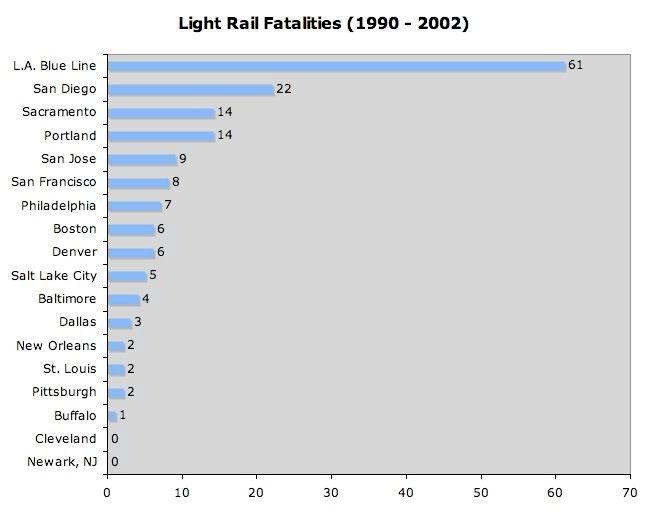
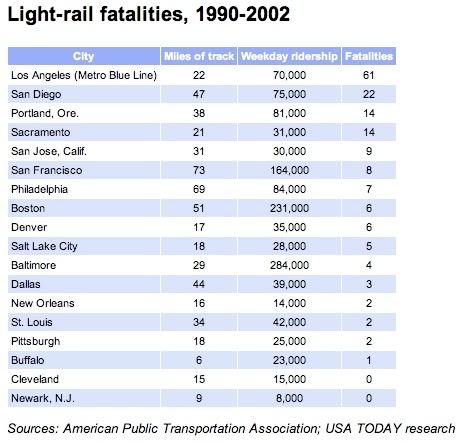
As mentioned in a previous post, in 2003, when USA Today compiled the American Public Transit Association statistics for light rail fatalities to compose their article, Blue Line takes a troubled route, in every category the Blue Line was the deadliest light rail system in the country. Here's a graph that compares light rail system deaths from 1990 (the Blue Line's first full year of operation) to 2002:


In an op-ed published in the LA Times titled "Rail Safety's Human Error Excuse," USC Professor Najmedin Meshkati, an internationally recognized expert in transportation system safety who testified on our behalf at the CPUC Evidentiary Hearing stated:

Are we to believe, for instance, that all crossing incidents were because of negligence when the death rate is so much higher here than almost any other place in the nation?
Regarding the Blue Line, MTA and predecessor agencies have spent billions building new rail lines: the Red Line, Green Line, and Pasadena Gold Line and still they haven't gone back to add grade separation to the black-eye of rail transit safety in the country, which is slicing through South LA, Compton, Watts and Willowbrook killing people (many of them children), on a consistent basis every year.  Instead, MTA proposes to replicate the most accident prone sections of the Blue Line in East LA on the Eastside extension and in South LA with the Expo Line.

In the $30-40 billion dollar measure put on the ballot by MTA there is not one penny for grade separations on the Blue Line, additional grade separations on Phase 1 of the Expo Line, or Metrolink safety upgrades. The transportation measure that is intended to set the course of the MTA for the next 30 years and there is not one penny to fix the current problems.

The reality is the culture of MTA and Metrolink, which are governed by our region's politicians, does not value lives. 

Our politicians have falsely translated our region's desires for traffic relief into a commuter rail and light rail system built on the cheap and unsafely.

Delivering Quimby's Testimony to the Board of Supervisors

FIX EXPO PREPARED STATEMENT BEFORE THE BOARD OF SUPERVISORS
September 23, 2008
Delivered by Damien Goodmon, Coordinator

We in the Fix Expo family have closely followed the catastrophic Metrolink accident in Chatsworth with deep pain, and we can only offer our condolences to the victims and their families.

The deceased were human beings who other human beings loved and needed.

In an op-ed published last Friday in the Daily News – which you have before you - we cautioned that solely focusing on actions of the train conductor distract us from discussing other contributing factors in the accident such as the technology and board policies, indeed our politicians rail-safety cost-benefit analysis.

For that reason we applaud Supervisor Antonovich for offering the Metrolink safety motion that will be discussed at Thursday’s MTA board meeting.

We at Fix Expo have been working on the issue of rail safety on the Expo Light Rail Line under construction in our South LA community. We have identified among our many opinions that we hold equally high concern for the safety hazard that the nearly three-dozen street-level crossings pose.

We have been fighting with you all requesting additional resources in South LA for life-saving grade separation.

To date we have received no support from any member of this board regarding even the most problematic street-level crossings on the rail line in front of 3,400-student Foshay Learning Center at Western and 2,100-student Dorsey High School.

Continue reading...

We came to you with the community organizations and you refused to change course.

We came to you with the LAUSD and you refused to change course.

We came to you with the UTLA, Parent Collaborative, and Neighborhood Councils and you refused to change course.

So I come today to bring you excerpts from the CPUC hearing testimony of an international rail safety expert – Major Russ Quimby.

Russ Quimby is THE international rail safety expert with impeccable credibility – a 1974 West Point graduate. In the 22 years he was at the National Transportation Safety Board he was the Investigator-in-Charge and/or Chairman of the Mechanical, Track, or Operations Investigation groups for all severity levels of railroad or rail-transit incidents, accidents and disasters.

He is the originator or major collaborator for over 157 NTSB adopted recommendations.

If Maj. Quimby hadn’t retired from the National Transportation Safety Board in 2007, he very likely would be the Investigator-in-Charge of the Chatsworth tragedy.

Here is what he’s said regarding the Farmdale crossing just 10 feet from Dorsey HS where over 700 students walk across the tracks in the 15 mins afterschool in surges up to 108 per min:
“[T]he proposed crossing at Farmdale Avenue…poses a higher risk of a catastrophic accident.”

“By ‘catastrophic accident,’ I mean an accident involving fatalities and/or injuries to a large number of people. As proposed, the at-grade Farmdale Avenue crossing creates the notable risk that a catastrophic accident may well occur under one of several different scenarios.”

Quimby then goes on to describe one scenario where a train hits a car and the car is lodged into the holding area where hundreds of children would be standing and/or the train derails. Another involves a car being hit by a train, rupturing the tank and fuel spraying onto children standing in the holding area. The third involves a combination of the two.

In the January LA CityBeat when saying why the Farmdale crossing must be built at street level, Supervisor Yarslavsky said, “The goal is to produce a product that your critics will come back to you and say, ‘You were right, we were wrong.'”

We fight at Fix Expo because Supervisors we don’t want to hear you say to us in 1 year, 5 years or 10 years after many have died, “The rail safety experts and community were right, we were wrong.”

We implore you Supervisors to Fix the Expo Line. Prevent tragedies. Save lives.

Our Daily News Op-Ed on the Metrolink Tragedy & the Systemic Rail Safety Problem

Our following op-ed appeared in the September 19 Daily News: Blaming Individuals Misses The Big Picture

Despite the fact that Metrolink operates one of the deadliest commuter rail systems in America and MTA operates the deadliest light-rail system in America, our region's rail transportation agencies continue to offer the lone-culprit theory for nearly every accident. This time it's the train conductor; in the past it's been the hundreds of deceased/injured motorist and pedestrian.

The blame the victim strategy distracts the public from the rail safety cost-benefit analysis that our transportation agencies continue to implement with impunity. It distracts the public from the manner in which our politicians have erroneously translated our requests for traffic relief into an unsafe commuter rail and light-rail system built on the cheap.

It may very well be true that in many rail accidents the transportation system's user bears some responsibility. But with accident rates so much higher than their peers, it does not logically follow that the policies and the designs of our rail transport systems are not a factor.
[....]
Blaming the victim or implying that accidents can't be prevented takes the spotlight off inadequate policies, unsafe designs and system failures.

Continue reading for the full op-ed:

Blaming Individuals Misses The Big Picture
LA Daily News
September 19, 2008
By Damien Goodmon


In the rush to judgment in the tragic Chatsworth accident, the focus has been on the actions of the train engineer conductor, a tactic that is beneficial to our transportation agencies.

As a rail safety advocate who for the past two years has been involved in an intense political and legal battle regarding rail safety of a proposed light rail line in my South L.A. community, that line of reasoning is all too familiar.

Despite the fact that Metrolink operates one of the deadliest commuter rail systems in America and MTA operates the deadliest light-rail system in America, our region's rail transportation agencies continue to offer the lone-culprit theory for nearly every accident. This time it's the train conductor; in the past it's been the hundreds of deceased/injured motorist and pedestrian.

The blame the victim strategy distracts the public from the rail safety cost-benefit analysis that our transportation agencies continue to implement with impunity. It distracts the public from the manner in which our politicians have erroneously translated our requests for traffic relief into an unsafe commuter rail and light-rail system built on the cheap.

It may very well be true that in many rail accidents the transportation system's user bears some responsibility. But with accident rates so much higher than their peers, it does not logically follow that the policies and the designs of our rail transport systems are not a factor.

For the past two years the South L.A. group, the Citizens' Campaign to Fix the Expo Rail Line, has been on the front lines of a battle with the Metropolitan Transportation Authority about rail safety. Our goal has been to secure investment in safety enhancements on the Expo Light Rail Line, which is currently under construction.

We are concerned that the line will have the same tragic consequences as MTA's Blue Line, which at 90 deaths and 821 accidents is the deadliest light-rail line in the U.S.

In our legal proceeding before the California Public Utilities Commission, the state's rail safety regulatory body, we've used the MTA and CPUC's own reports, statistics, internal memos and e-mails to explain why the street-level Expo Line crossings will be deadly. World and nationally renowned authorities on transportation system failures, human error, rail accident causation, and car accident causation have testified on our behalf.

At each turn our broad coalition and our rail safety experts have been dismissed by the politicians on the MTA and subsidiary boards citing as their reasons: The recommendations and requests are cost-prohibitive, would cause delay, or "would violate their policy."

Blaming the victim or implying that accidents can't be prevented takes the spotlight off inadequate policies, unsafe designs and system failures. Whether it's implementing more active alert systems, building new tracks so freight trains don't operate on the same track as Metrolink, or adopting as a standard that light-rail trains be built elevated or underground in densely populated congested urban spaces, our transportation agencies can be doing so much more than they are right now.

We cannot allow the Chatsworth accident report to be shelved, the investigation mustn't be limited to just this one accident, and we cannot accept as an explanation that the engineer conductor, was only to blame. An independent systemwide top-to-bottom critique that evaluates every policy and budget decision with the goal of creating a series of recommendations is the very least we must do to honor the memories of the victims of last week's accident and the countless many who have been killed on our region's tracks before them.

Give Blood for Metrolink Crash Victims

By now most have heard of Friday's terrible tragedy that occurred in Chatsworth, near the Ventura County border, as a Metrolink and freight train collided head-on. At last count 25 individuals have passed, over 60 remain in critical condition, and dozens more are wounded.

The large number of injuries has resulted in a call for healthy blood donors. For those that can give blood, please contact the UCLA Blood and Platelet Center, which is open Monday through Friday. To make an appointment call (310) 794 - 7217 extension 2.

Please keep the families and the victims in your prayers.

Damien Goodmon
Coordinator
Citizens' Campaign to Fix the Expo Rail Line

Why do we fight for grade separation?

Recently Russ Quimby an internationally recognized expert in rail accident causation and investigations submitted testimony in the CPUC hearing regarding the two crossings closest to our South LA community schools: Farmdale Ave (10 feet from Dorsey HS) and Western Ave (50 feet from Foshay Learning Center).  

Here's an excerpt of his professional evaluation of the Farmdale Avenue crossing:
As proposed, the Farmdale Avenue crossing creates a high risk that students will be injured and killed because the proposed safety mitigation measures essentially put the burden on students to maintain their own safety. The proposed crossing also creates a higher risk of a catastrophic accident. [....]

By "catastrophic accident," I mean an accident involving fatalities and/or injuries to a large number of people. As proposed, the at-grade Farmdale Avenue crossing creates the notable risk that a catastrophic accident may well occur under one of several different scenarios.  For example:
First, that a train will collide with a vehicle with sufficient force to either derail the train into and/or push the vehicle into the proposed "holding pens" where several hundred students are trapped inside, killing or seriously injuring scores of students in a single accident.
Second, that a train will collide with a vehicle (particularly a truck or bus) rupturing and igniting a fuel tank which would engulf students in the holding pen in flaming diesel or gasoline.
Third, a combination of the above two scenarios where the students are crushed and burned simultaneously by vehicles and/or a derailed train.

You don't have to look far to see that just these types of accidents (car gets hit by train and train derails, and/or catches on fire).  In fact, you can look to the MTA's very own Gold Line, which the Expo Authority calls "safe":


When you think of the word "SAFE" is this the image that comes to mind?

That crumbled piece of metal that looks like a big potato chip bag is a former SUV that upon impact with the train caught on fire.

Video from the accident is below.


Led by the same project managers who told the communities around the Gold Line that it would be safe and that accidents like that would never happen, the MTA now tells us a train that crosses major streets like Crenshaw, Western, Normandie and Vermont without even basic crossing gates, and passes 10 feet of Dorsey HS is "safe."

We're being told this by the MTA - an agency that operates the Blue Line, which at over 821 accidents and 90 deaths is the deadliest light rail line in the country.


Today the number is up to 90 people DEAD and over 821 accidents.  
Does that sounds safe to you?

Here's the chaos at Farmdale/Exposition, where every day after school 700 kids in 15 mins (up to 108 per min) flood the tracks.  There's nothing like it anywhere on MTA light rail system:


MTA plan for this crossing is not grade separation, but instead, what they originally called a "holding pen," akin to that for a penal institution or for cattle:


The "protection" MTA proposes for OUR South LA kids at Dorsey HS every day for the next 100 years is a holding pen.

We fight because we don't want to prove Russ Quimby right.  We don't want that holding pen - we won't accept an at-grade crossing here.

Dozens of children have already been killed on the tracks of MTA's trains.  Children that successfully crossed the tracks thousands of times, but just one day at one time was caught in a bad circumstance.  They are gone now.

Tell the MTA, PUC and our elected officials to FIX EXPO, by giving South LA equal investment, equal treatment and the same safety as the end of Phase 1 from La Cienega to Robertson.  We don't want to have to bury any more children because of MTA's unsafe street-level crossings.

Major Battle Victory at the PUC

(As covered in CityWatchLA)

At the California Public Utilities Commission Hearing Monday on the Expo Line crossings by Dorsey High School and Foshay Learning Center, the assigned Judge Kenneth Koss issued the following statement as part of his ruling:

"With the submission of Expo's information it appears that a grade separation at Farmdale is in fact practicable."

This means that the street-level application with the holding pen is off the table.

The only options are:
a) underpass
b) overpass
c) street closure with a pedestrian bridge

This a major victory for the Dorsey High School family - for the future children of Dorsey HS.

Here’s some of the leadup to the hearing.

The Expo Authority since February has been conducting a study on alternatives to the street-level railroad crossing at Farmdale right by Dorsey HS.

Since April, both our attorneys and the LAUSD lawyers have been requesting the study. Expo has refused to supply it, including during discovery. They were ordered to supply it by the Judge and still they have not. Yet, in June, Expo produced testimony stating that this study showed that closing off Farmdale and building a pedestrian bridge was not possible because it would have adverse traffic impacts on the adjacent crossing of Buckingham that could not be mitigated and would not comply with the California Environmental Quality Act (CEQA). Again we requested the study and they failed to supply it.

The LAUSD and our attorneys supplied our testimony in response to Expo's testimony August 6 and July 30 respectively.

Our lawyers filed a request for a continuance on August 7 because of the failure of Expo to supply the document, along with motions to eliminate from the record any reference of Expo's witnesses to the study since Expo refused to supply it. The same day, the Judge denied the request for the continuance and stated the other matters would be addressed on Monday.

On night of August 8, at 7:30 pm, Expo sent amended testimony COMPLETELY REVERSING their position that they could not close Farmdale and on Saturday night they submitted another 75 pg document showing how it would legally comply with CEQA.

The LAUSD is quite clear in their statement:
"We can reasonably infer from such changes in Expo's Friday night revised testimony that the 'draft' traffic study found adverse impacts that would have to mitigated, so Expo commissioned another study to reach a conclusion more to its liking."

Accordingly, the LAUSD has requested they be supplied all of Expo's draft studies to determine the extent of the manipulation by the Expo Authority:
"These studies will provide a window into Expo's apparent manipulation of technical studies to serve its litigation interests in this case. To the extent is shows that Expo has suppressed studies with conclusions not to its liking and has commissioned other studies that later the assumptions or methodologies to arrive at different conclusions, that practice is highly relevant to the weight this Commission should give to Expo's witnesses' testimony. To ignore such practices and to accept the project proponent's technical assertions at face value would make a mockery of this hearing."

Judge Koss answered the question of MTA motives with his Monday decision.

Thank You for Coming Out to a Great Protest!

Thank you to the hundreds who showed up at Foshay and Dorsey yesterday to rally for safety and grade separation on the Expo Line. A special thanks to the brave and able many who marched the 2.5 miles in between, and those who spent their Friday night before the protest making our great signs.


It is Time to Take Our Fight to the Streets!

As reported by Betty Pleasant in this week's The Wave, this Saturday, August 9th the LAUSD and United Teachers Los Angeles will lead a protest that we're supporting opposing the unsafe street-level railroad crossings near our community's schools.

The goal is to send a message to the MTA and Public Utilities Commission that we do not support the MTA's proposed Expo Line Phase 1 design that forces no child west of La Cienega to walk across the tracks, but forces thousands of South LA children to walk across the tracks every day for the next 100 years (link and pdf). Show up to stand up for our community and children's safety!

The schedule for Saturday's activities is as follows:

9 am - 10 am:
Assembly at Foshay Learning Center (Western/Exposition)

10 am - 11 am:
Solemn walk, bike, drive, jog to from Foshay to Dorsey HS (Farmdale/Exposition)

11 am - Noon:
Assembly at Dorsey High School to plan next steps

(Download the LAUSD's bilingual flyer)

WE DID IT! PUC Evidentiary Hearing Moved to Los Angeles

An Important Battle Victory in a Our Struggle

As reported in the LA Watts Times last week, we won an important battle in our struggle, as the Public Utilities Commission ("PUC") moved the location of the evidentiary hearing from San Francisco down to Los Angeles. The PUC is one regulatory body that can prevent MTA from building the trains at street level.

Holding the hearing is San Francisco would have been a logistical nightmare for us and prevented several of our witnesses from testifying. But because of YOU and YOUR emails and letters, and YOUR ACTION through your presence and statements of concern at the July 2nd PUC Workshop at Foshay we were victorious.

Special thanks go to State Senator Mark Ridley-Thomas, who promptly responded to the concerns of the community by sending the first letter to the PUC requesting the hearing be moved to Los Angeles. Thanks also go to Assembly Speaker Karen Bass, Assembly Member Mike Davis and even Council Member Herb Wesson for writting letters and contacting the PUC.

The hearings will be held daily from August 11 to August 15 beginning at 10 am and ending at 5 pm at the PUC's Downtown Los Angeles hearing room:

320 W. 4th Street Suite 500
Los Angeles, CA 90008

Street-Level Debacle - LA Business Journal Op-Ed

The following op-ed appeared in the July 28, 2008 edition of LA Business Journal, regarding the Mayor's proposed sales-tax increase for transportation.

Shared tax burdens should result in shared benefits. Thus, if the MTA and mayor hear the concerns of South L.A. and invest in life-saving and community-preserving grade separations, particularly near our schools, we’re prepared to support his sales tax hike. But expecting South L.A. taxpayers to accept the street-level Expo Line design, while forcing us to pay for a subway under Hancock Park, Beverly Hills and Century City, is simply adding insult to injury and furthering MTA’s discriminatory tactics.

The entire article is below:

Street-Level Debacle

MTA expects South L.A. to bear the burden of proposed Expo Line and its dangerous above-ground trains.
By DAMIEN GOODMON

In his effort to build the Wilshire subway western extension to Santa Monica, Mayor Antonio Villaraigosa, who chairs the Metropolitan Transportation Authority board, has proposed increasing the regressive sales tax in the face of an economic downturn that is hitting the vulnerable taxpayers, consumers and businesses of South Los Angeles the hardest.

The mayor’s request for sacrifice from his South L.A. constituents for the Subway to the Sea is audacious given his unresponsiveness to the large South L.A. coalition requesting equal investment and equal treatment from the MTA regarding Phase 1 of the Expo Light Rail Line.

As it traverses from downtown L.A. to Culver City, the 8.5-mile Expo Line is proposed to slice across nearly all intersections in South L.A. at street level 240 times a day. In addition to the adverse traffic impacts, noise pollution and other environmental concerns, the street-level design poses a significant safety hazard, with 225-ton trains planned to operate at speeds up to 35 and 55 miles an hour. At Vermont, Normandie, Western and Crenshaw, which abut large urban schools, parks and places of worship, crossing gates aren’t even proposed. Twenty one of the 27 proposed street-level crossings have no gates.

This design has proved to be unsafe, evidenced by the accident record of the MTA’s Blue Line, which en route to Long Beach from downtown L.A. carves through the communities of South L.A., Watts, Willowbrook and Compton, and is the deadliest light rail line in the country with 818 accidents and 90 deaths.

The Expo Line’s close proximity to more than a dozen schools, in particular the 2,100-student Dorsey High School (which would be 10 feet from the tracks) and 3,500-student Foshay Learning Center (50 feet from the tracks), has prompted resolutions opposing all or portions of the street-level design from United Teachers Los Angeles and LAUSD Parent Collaborative, and legal action by the LAUSD Board of Education. All are concerned that children will be lost, such as 14-year-old Lavert Baker Jr., who never made it home from school last year because he was killed by a Blue Line train that was carrying his sister. Lavert is one of more than a dozen youths and young adults who have met similar unfortunate fates on the tracks of MTA trains.

Throughout the planning stages of the Expo Line, all parents, teachers and residents expressed concerns about the safety and environmental impacts of the street-level design – in South L.A. and in Culver City. The Culver City City Council heard the voices of its constituents and responded by passing motions prohibiting the street-level crossings the MTA had originally planned for their city.

Recognizing the power of a municipality, MTA bowed to Culver City’s demands, adding very costly overpasses, realigning National Boulevard and shifting a station platform so that Phase 1 of the Expo Line would not have any street-level crossings west of La Cienega Boulevard. The result is a 100-year project that west of La Cienega requires no child to walk across tracks, gridlocks no traffic, delays no emergency services, and inflicts no noise pollution, while imposing all of these burdens and more east of La Cienega in South L.A.

This discrepancy is perhaps best illustrated by the vast disparity in the amount of tax dollars MTA is spending for the one mile of the Expo Line from La Cienega to the Robertson Boulevard terminus in Culver City ($185 million for the one mile) compared with the 4.5 miles in South L.A. (just $31 million per mile, for a total of $140 million).

South L.A. paid its taxes for Phase 1 of the Expo Line: $35 million from the city of L.A. versus just $4 million from Culver City. Yet, we’re receiving a substantially lower return, and expected to bear greater hardship, including the ultimate calamities – the loss of life and limb.

Shared tax burdens should result in shared benefits. Thus, if the MTA and mayor hear the concerns of South L.A. and invest in life-saving and community-preserving grade separations, particularly near our schools, we’re prepared to support his sales tax hike. But expecting South L.A. taxpayers to accept the street-level Expo Line design, while forcing us to pay for a subway under Hancock Park, Beverly Hills and Century City, is simply adding insult to injury and furthering MTA’s discriminatory tactics.

Political Interference in the CPUC Judicial Process

While the South LA community was fighting to literally protect children’s lives, our own elected representative, Council Member Bernard Parks, along with Santa Monica politician State Senator Sheila Kuehl, were applying pressure on judicial officers of a State oversight agency to impede our efforts in court.

The South LA community, teachers, parents, and child advocates have long expressed reservations about the unsafe street-level design of the Expo Light Rail Line, particularly around our schools like Dorsey HS (10 feet of the railroad crossing) and Foshay Learning Center (50 feet of the crossing). The state oversight agency for the safety of all rail crossings is the California Public Utilities Commission (“CPUC”). All transportation agencies attempting to build and operate a rail line across any street in California must submit applications and receive approval from the CPUC. The CPUC can either approve or reject a crossing application on the grounds of safety, and has rejected countless railroad crossing applications in the past.

One of the lead groups of the Fix Expo Campaign, Expo Communities United (“ECU”), exercised its legal rights by protesting all of the unsafe street-level Expo Line applications, and requesting a hearing to discuss the safety hazards and needed safety upgrades. In the process ECU delayed what would have been a 60-day rubberstamp process.

The ECU research team amassed an extensive record proving that the street-level crossings were not safe. Among the evidence submitted were:
a) internal memos expressing reservations about the safety of the crossings by the staff of numerous public agencies, namely the PUC’s own engineers & former LADOT General Manager Gloria Jeff; and
b) a convincing showing that the bulk of the Expo Line design was an exact replica of the deadliest & most accident-prone light rail line in America, the MTA’s Blue Line, & would operate in more complex environments, meaning even more accidents & deaths could be expected. Surely an opportunity to argue the case would be provided, further lengthening the application process.

Unexpectedly, on August 14, 2007 Commissioner Timothy Simon, one of five governor-appointed representatives to the CPUC, and the assigned Commissioner to the Expo Line case issued an “Open Letter to Lawmakers Regarding the Expo Line Proceeding," stating that he was receiving pressure from local legislators to expedite the case. In the letter Simon stated that he considered approving the applications and expediting the case “of the highest priority.” Commissioner Simon specifically said, “approving these applications” as though a determination had already been made, even though ECU and LAUSD had yet to present their cases to the CPUC.

In an email on November 19, 2007 (pdf), Commissioner Simon’s Chief of Staff identified the legislators who were contacting him with concerns about the “time consuming process of approving these applications” that led to the Open Letter:

  • STATE SENATOR SHEILA KUEHL (Santa Monica)
  • COUNCIL MEMBER BERNARD PARKS, who represents the area where the Expo Line passes within a stone’s throw of sensitive sites like Foshay Learning Center, and operates without even basic crossing gates in a design that is exactly like one of the most accident-prone sections of the Blue Line.
When the letter was issued, Simon had not yet been confirmed to the Commission by the California State Senate, in which Sen. Kuehl is a very influential member. Simon’s eventual confirmation hearing, which occurred months later, was filled with controversy about his ethics (PUC Member’s Donation Request Raises Questions – LA Times). At the time Kuehl was also pushing legislation to remove the jurisdiction of rail crossing safety from the CPUC.

And we have confirmed that Bernard Parks has been accepting donations for his campaign for County Supervisor from MTA and Expo Line contractors in violation of California law.

Download the flyer of the above text click here

Fix Expo Op-Ed on Mayor’s Transportation Sales Tax: Racism & Reverse Robin Hood

Our op-ed on the Mayor's proposed 1/2-cent sales tax increase for transportation appeared in CityWatch:


"The discrepancies on the Expo Line need to fixed and this institutional discrimination cannot be tolerated. If the MTA and Mayor Villaraigosa go back and find the additional money for grade separations for South LA like they did for Culver City, or simply scale back the Expo Line and only build the portions they can afford to build correctly, we're prepared to support his sales tax measure.

"But increasing the tax burden on the taxpayers of South LA, who are being hit the hardest by the economic downturn, for rail projects that primarily benefit other areas, like a subway under Hancock Park, Beverly Hills and Century City, or threaten our children's lives and harm our community, like the street-level design of the Expo Line is simply pouring salt on our wounds and furthering MTA's discriminatory tactics."


Click here to read the entire article:

Discussion of a possible ½-cent sales tax increase for transportation that would be forced upon all residents of Los Angeles County has been dominated by Westsiders and the Valley, with those regions demanding something in return for their support. What about the South Los Angeles region, which is among the country's most economically challenged and whose residents and businesses the tax hike would impose the greatest hardship?

A growing South Los Angeles coalition of neighborhood councils and community organizations, has come together to demand equal investment and equal treatment from the MTA regarding Phase 1 of the Expo Light Rail Line from Downtown LA to Culver City. En route to Culver City the MTA's train is planned to cut through South LA residential community across the major intersections of Vermont, Normandie, Western and Crenshaw at street-level.

In addition to the adverse traffic impacts of the street-running design, the lack of even basic crossing gates and grade separation (overpasses and underpasses) at almost all of the intersections, ensures that South LA will endure countless accidents and deaths from the Expo Line, as evident by the MTA's own Blue Line. The Blue Line similarly slices through the black and brown communities of South LA, Watts, Willowbrook and Compton en route to Long Beach from Downtown LA, and is America's deadliest light rail line.

The close proximity of over a dozen schools and parks, including several that are within a stones throw of the Expo Line, is especially worrisome, and has prompted opposition to all or portions of the street-level design from UTLA, LAUSD Parent Collaborative, and the LAUSD Board of Education.

In the early planning stages of the Expo Line, all residents, teachers and parents expressed safety and environmental impact concerns - in South LA and in Culver City. The Culver City Council responded by passing a motion prohibiting any street-level crossings in their city and threatening to tie the project up in court if the MTA tried to push through their original design that called for all street-level crossings in their city.

MTA eventually complied with Culver City's demand, adding very costly overpasses and realigning National Blvd so the Expo Line would not cross any street at street-level, thereby imposing no safety risk, no traffic impact and eliminating other adverse impacts. These upgrades came at a price, which is best illustrated by the vast discrepancy in the amount of tax dollars MTA is spending for the one mile of the Expo Line from La Cienega to the Robertson terminus in Culver City ($185 million) vs. the 4.5 miles in South LA (just $140 million).

The MTA's failure to apply the same standards across all residential communities from Downtown LA to Culver City has resulted in an 8.5-mile light rail line that places all of the safety hazards and adverse environmental impacts on low-income and/or minority communities, and none on the majority Caucasian middle to upper class community west of La Cienega. The legal term for this is environmental racism.

We in South LA paid our taxes, but are not receiving the same safety enhancements, traffic mitigation or amount per mile as the community west of La Cienega. In fact, the City of Los Angeles is contributing $35 million to the construction of the line, compared to just $4 million from the City of Culver City.

South LA is being forced to assume a much higher risk, and be imposed a much greater burden for a project that's primary purpose is to benefit the areas to our east and west. That's not right.

Children in South LA shouldn't be forced to walk across Expo Line tracks, if they won't be in Culver City.

Residential communities, traffic and emergency response times shouldn't be disrupted in South LA, if they won't be in Culver City.

The discrepancies on the Expo Line need to fixed and this institutional discrimination cannot be tolerated. If the MTA and Mayor Villaraigosa go back and find the additional money for grade separations for South LA like they did for Culver City, or simply scale back the Expo Line and only build the portions they can afford to build correctly, we're prepared to support his sales tax measure.

But increasing the tax burden on the taxpayers of South LA, who are being hit the hardest by the economic downturn, for rail projects that primarily benefit other areas, like a subway under Hancock Park, Beverly Hills and Century City, or threaten our children's lives and harm our community, like the street-level design of the Expo Line is simply pouring salt on our wounds and furthering MTA's discriminatory tactics.

Recent Press

Several links to recent press on this issue have been added to the "Press" section on the right hand column.

  • A brief blurb about Gloria Molina's comments regarding the equity in transit funding at Thursday's MTA Board Meeting appeared in the LB Press-Telegram:
Molina, in particular, expressed her displeasure during the MTA meeting that the tax would fund a subway to the Westside, while East Los Angeles and South Los Angeles have been allocated cheaper above-ground light rail systems.

"When it goes to the west side of town, they get a subway. When it went to the east side of town, you had to get light rail above ground," Molina said, calling light rail a "second-class system." Molina later retracted that statement, but maintained that above-ground rail was less convenient and noisier than subways.

"We were ripped off of our subway," she said
  • This excerpt from our Public Records Act request of Bernard Parks appeared in Betty Pleasant's June 26th Soulvine:
THESE ARE PIT BULLS! — Expo Communities United, the group organized to deal with the Exposition Metro Line scheduled to cut a swath through residential neighborhoods from downtown L.A. to Culver City, is a tenacious bunch. In its ongoing fight for safety amendments to the Expo Line’s plans, the group has invoked the California Public Records Act and requested of Councilman Bernard Parks that he, personally, provide the organization a whole lot of documents pertaining to the Expo Line’s construction. The June 6 CPRA request was signed by Expo Communities United leaders Damien Goodmon, Clint Simmons and Carol Tucker, and pursuant to the law, Parks has until the close of business tomorrow to comply — or else.
  • This excerpt from our complaint filed with the Fair Political Practices Commission regarding Parks' illegal campaign donations from MTA contractors appeared in Betty Pleasant's May 29th Soulvine:
The Citizens’ Campaign to Fix the Expo Line filed a complaint, along with exhibits, Tuesday with the Fair Political Practices Commission alleging that Councilman Bernard Parks, appointee to the MTA and the Expo Authority boards of directors, is bankrolling his campaign for the 2nd Supervisorial District with contributions from MTA contractors in violation of three state conflict of interest laws. On Wednesday, the group filed a complaint on the same allegations with the state Attorney General’s Office.

The Environmental Justice Fact Sheet

We've uploaded our Environmental Justice Fact Sheet to the web (link to pdf). You can access the document, along with all of our other flyers and fact sheets on the right hand corner under "Fact Sheets & Forms"

UTLA Stands Up for Our Children & Schools

On January 16, 2008, the United Teachers Los Angeles House of Representatives stood up for the safety of children and the preservation of learning environments through HOR 11-7-07 Special Order #13:

Moved by Elaine LeBoeuf, seconded by Susie Chow that UTLA oppose the construction of the Expo Rail Line (light rail) as it is proposed. At least 5 schools are less than 100 feet from the at-grade (street level) rail which will be an extreme hazard to students, teachers and the general public. UTLA recommends that MTA build the train totally grade separated as it will be in Culver City and underground (as it will be at Figueroa Street at USC) in this high density area. Noise pollution is also a concern. Take it back to [the] Commission for a safer proposal.
Rationale: We are concerned about the safety and welfare of [the] general public (dogs and cats, too) in this densely populated area. Students will have difficulty concentrating with bells and whistles every 2 1/2 minutes. Sound walls can't be constructed to mitigate this circumstance.

Special thanks go to UTLA Dorsey HS Chapter Chair Noah Lippe-Klein, and UTLA Community Relations Chair Elaine LeBoeuf.

The motion can be downloaded by clicking here.

LAUSD Board of Education Stands Up for Children's Safety & Learning Environments

(Schools within 1/3rd of a mile of the Expo Line)

At their November 13, 2007 meeting, the LAUSD Board unanimously adopted the Keeping Kids Safe Resolution presented by Board Members Marguerite LaMotte & Julie Korenstein supporting the position of the community requesting Expo Line grade separation at Farmdale (Dorsey HS), opposing Expo Line at-grade crossings in close proximity to school sites that aren't sufficiently mitigated, and directing their legal department to fight to such ends.

Continue reading to view the full text of the resolution:
Whereas, The Metropolitan Transportation Authority's (MTA) Expo Light Rail Line is proposed to operate primarily at-grade;

Whereas, According to the Summary of Metro Blue Line Train/Vehicle and Train Pedestrian Accident Report (7/90-6/07), in 17 years of operating primarily at-grade, the Metro Blue Line has become the nation's deadliest and most accident-prone light rail line in the country, and statistics indicate 88 deaths and 795 accidents have occurred in urban areas with lower vehicular and pedestrian traffic volume and residential density than the Expo Rail Line corridor;

Whereas, The proposed Expo Line's median-running and side-street running designs from the intersection of 11th and Flower Streets to Arlington Avenue and Exposition Boulevard is the exact replica of the most accident prone portion of the MTA's Blue Line;

Whereas, The Los Angeles Unified School District Distance Criteria for School Siting precludes schools from being built within 128 feet of an active rail line; unless the risk is found to be less than significant;

Whereas, The property line of Susan Miller Dorsey High School, with a student population of over 1,600, is within 20 feet of the proposed at-grade Expo Rail Line crossings;

Whereas, The property line of Foshay Learning Center, with a student population of over 3,400, is within 50 feet of the proposed at-grade Expo Rail Line crossings;

Whereas, The Expo Line is proposed to operate within walking distance of Foshay Learning Center, Theodore T. Alexander Science Center Elementary School, Weemes Elementary, Baldwin Hills Elementary School, and Dorsey High School;

Whereas, On a daily basis thousands of students walk in close proximity and cross the Expo Line tracks, which encompasses several safe passage school routes;

Whereas, To ensure a quality learning environment, interior and exterior noise levels must maintain acoustical standards not exceeding American National Standards Institute guidelines (ANSI S.12.60-2002) and criteria established by the Collaborative for High Performing Schools (CHPS);

Whereas, The Expo Rail Line trains will blow its horns on approach and through each at-grade crossing near District schools as frequently as 30 times per hour;

Whereas, Horn blowing would not be required if the Expo Line is constructed above or below grade, and noise impacts would be significantly reduced;

Whereas, The increased traffic and vehicles idling near the school sites will have an adverse effect on the health of school occupants;

Whereas, MTA is making the investment to eliminate all at-grade crossings on the Expo Rail Line in the City of Culver City; and

Whereas, MTA is making the investment to construct an underpass at Figueroa Street and Exposition Boulevard adjacent to the University of Southern California; now, therefore, be it

Resolved, That the Los Angeles Unified School District supports the position of the community, which opposes the at-grade design of the Expo Light Rail Line at the Farmdale crossing;

Resolved further, That the District is opposed to the operation of any at-grade design of the Expo Light Rail Line along streets in close proximity to school sites, unless it is demonstrated that alternative mitigation measures will eliminate all safety hazards; and be it finally

Resolved, That the Governing Board of the Los Angeles Unified School District directs the Superintendent to exhaust all legal options in working with the MTA to eliminate all at-grade crossings along the proposed Expo Line that present a significant risk to pedestrian safety.

The Resolution can be downloaded in pdf format by clicking here.